
If you’ve ever stepped out into your garden at night and struggled to see where you’re going — or noticed that one harsh floodlight doing all the work — you’ll know how limiting it can feel.
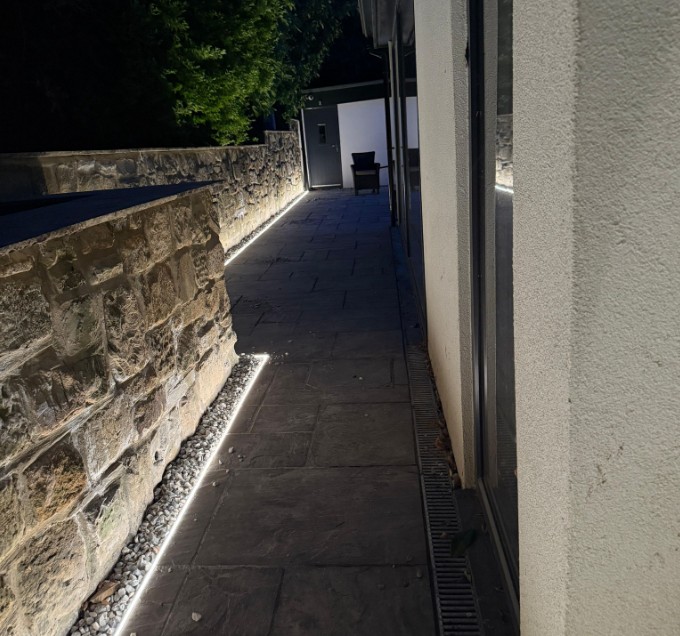
It’s something we come across all the time in homes around Leeds and the surrounding areas. The garden itself is usually well thought out, but the lighting is often an afterthought.
You might have:
- A couple of basic lights near the back door
- One overly bright fitting lighting half the garden
- Or nothing at all beyond what spills out from inside
It works, technically. But it doesn’t make the space feel safe, usable, or particularly enjoyable once the sun goes down.
The real role of garden lighting
In most cases, people think garden lighting is just about being able to see.
But when it’s done properly, it does a lot more than that.
Good outdoor lighting should:
- Help you move around safely
- Highlight key features in the garden
- Create a comfortable atmosphere in the evening
- Extend how you use the space beyond daylight hours
It’s likely that you’ve invested time and money into your garden — seating areas, landscaping, maybe even an outdoor kitchen — but without the right lighting, it all disappears at night.
Where standard lighting setups fall short
A lot of outdoor lighting setups are either too basic or too aggressive.
We regularly see:
- Single-point lighting that creates harsh shadows
- Overpowered floodlights that flatten the space
- Poor positioning that causes glare or dark spots
- Manual switching only, meaning lights are often left off or left on unnecessarily
It’s a common issue, and it usually comes down to a lack of planning rather than the products themselves.
The best way to deal with this is to treat garden lighting as a proper system — not just a few fittings added here and there.
What makes lighting “smart” — and why it matters
When we talk about smart garden lighting, we’re not talking about anything overly complicated.
In most cases, it simply means your lighting works with you, rather than needing constant input.
That includes things like:
- Lights coming on automatically at dusk
- Different areas controlled independently
- Adjustable brightness depending on how the space is used
- Simple control from your phone or a wall switch
What we’d usually recommend is setting up your lighting so it adapts to how you actually use the garden.
For example:
- A softer setting for everyday evenings
- Brighter pathways for safety when needed
- A more vibrant setup when you’re entertaining
It’s about flexibility — without making things complicated.
Why safety should never be an afterthought
This is the part that often gets overlooked.
Outdoor lighting isn’t just about how things look — it plays a big role in safety around your home.
In most gardens, there are natural hazards:
- Steps and level changes
- Uneven paving
- Slippery surfaces in wet weather
- Poorly lit boundaries
Without proper lighting, these become much more of a risk, especially when you’ve got guests over who don’t know the layout.
The best way to deal with this is to build safety into the design from the start.
That usually means:
- Clearly lit pathways
- Subtle lighting on steps and edges
- Even coverage without harsh glare
- Reliable fittings designed for outdoor use
It can usually be sorted fairly simply, but it makes a big difference day to day.
Building the right lighting layers
One of the biggest differences between a basic setup and well-designed garden lighting is layering.
Instead of relying on one type of light, you combine different elements to create balance.
Here’s how that typically looks:
Uplighting
Uplighters are used to highlight features from below — things like trees, walls, or architectural details.
They add depth and draw your eye to key parts of the garden.
In most cases, this is what gives a garden that finished, high-end look in the evening.
Downlighting
Downlights are positioned higher up — often on walls, soffits, or structures — and cast light downwards.
They’re ideal for:
- Seating areas
- Patios
- Outdoor kitchens
They create a more natural, soft light that feels comfortable to sit under.
LED strip and neon flex
These are great for adding subtle detail and guiding movement through the space.
You’ll often see them used:
- Along steps
- Under seating
- Around edges of patios or planters
They’re low-profile but very effective, especially when it comes to safety and visibility.
Feature and accent lighting
This is where you can be a bit more selective.
Highlighting planting, water features, or specific design elements helps bring the whole space together.
It doesn’t need to be overdone — in most cases, less is more.
How it all comes together
When these elements are combined properly, the result feels natural — not over-lit or artificial.
You get:
- Clear, safe movement around the garden
- A balanced level of light across different areas
- Visual interest without harshness
- A space that feels usable and comfortable at night
We deal with this regularly, and it’s one of those upgrades that completely changes how people use their garden.
Control without complication
One of the biggest concerns people have about garden lighting Leeds is whether it’ll be difficult to use.
In reality, it should be straightforward.
What we’d usually recommend is:
- Simple preset scenes (e.g. “Evening”, “Entertaining”, “Off”)
- Automatic timers or dusk sensors
- Easy manual override when needed
So instead of thinking about switches and settings, the lighting just does what you expect it to do.
That’s the goal.
Can this be added to an existing garden?
In most cases, yes.
You don’t need to start from scratch to improve your outdoor lighting.
There are usually practical ways to upgrade your garden lighting:
- Adding new fittings in key areas
- Improving control and automation
- Replacing older or poorly positioned lights
- Bringing everything together into one simple system
The key is understanding how the space is used and designing around that.
Why it’s worth doing properly
It’s easy to underestimate the impact of good lighting.
But once it’s in place, it changes how the space feels entirely.
You’ll likely find:
- You use the garden more in the evenings
- It feels safer and easier to move around
- The space looks more considered and complete
- Entertaining becomes more relaxed and enjoyable
It’s not about adding more light — it’s about adding the right light.
Thinking about upgrading your garden lighting?
If your current setup feels a bit limited, or you’re planning garden lighting leeds it’s worth getting a proper plan in place from the start.
We’ll give you a clear, honest assessment of what would work best for your garden — without overcomplicating things.
If you’ve got a rough idea, or even just want a bit of guidance, get in touch.
Happy to take a look and advise.