
You’ve clicked our NAPIT badge – here’s what it actually means
If you’ve clicked the NAPIT badge on our website, there’s a good chance you’re checking who we are, whether we’re genuinely registered and what that registration actually means.
That’s exactly what we’d encourage you to do.
SmartOhm Electrical and Smart Home is a NAPIT registered electrical contractor covering Leeds and surrounding areas, and we’ve been registered with NAPIT since 2023.
But having a badge on a website doesn’t mean much unless you understand what sits behind it.
Being NAPIT registered isn’t simply a case of joining an organisation and displaying a logo.
Our electrical competence has been independently assessed for the categories of electrical work we’re registered to undertake, and our registration is subject to ongoing assessment.
NAPIT’s electrical schemes are there to assess and demonstrate competence, with its consumer guidance explaining that certificated scheme members have demonstrated competence and must have the appropriate processes and procedures in place.
For you as a customer, that gives another level of reassurance.
You’re not simply relying on us telling you that we know what we’re doing.
There is independent assessment behind the badge.
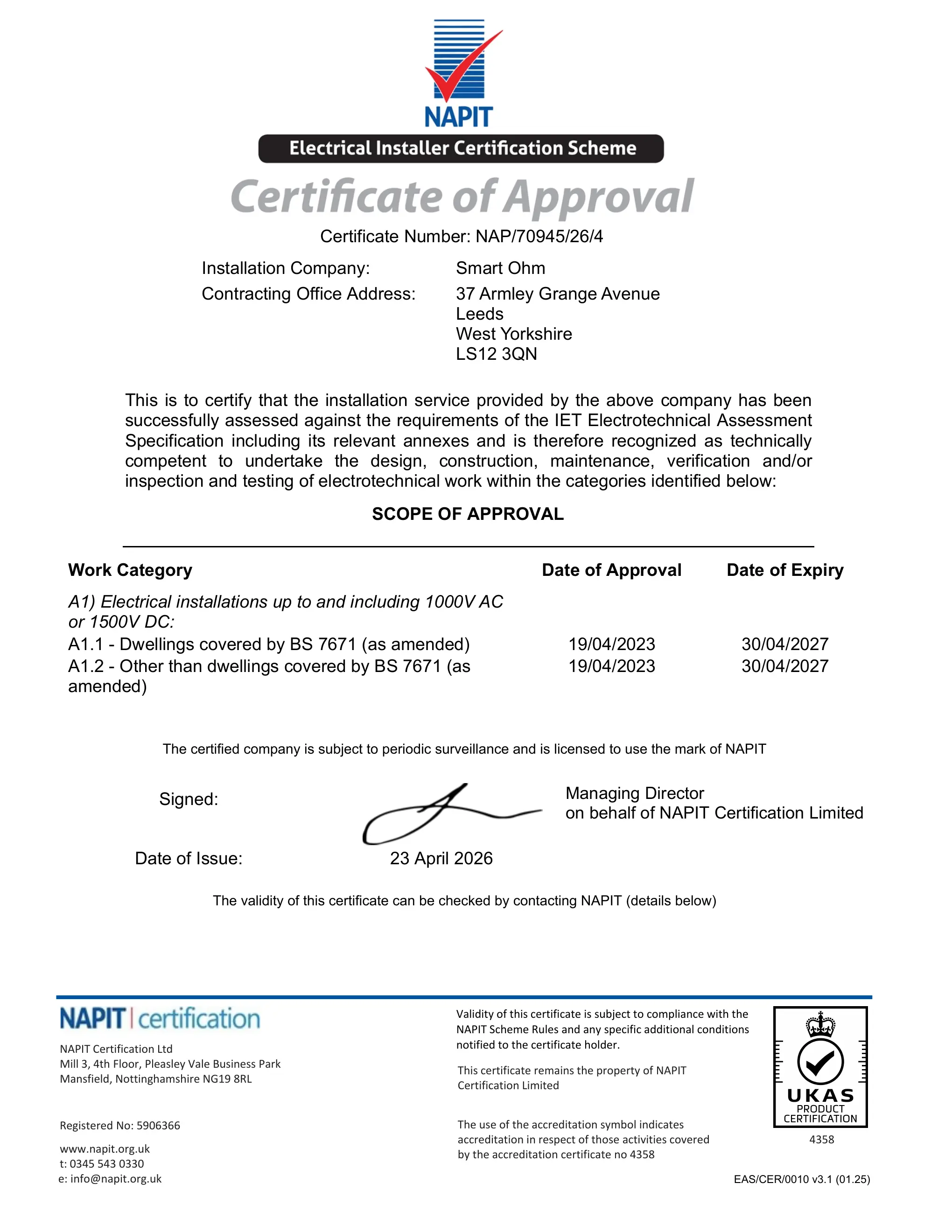
NAPIT Certificate Number: NAP/70945/26/4
Why does using a registered electrician matter?
Most homeowners aren’t particularly interested in electrical schemes, certificate numbers or Building Regulations.
And you shouldn’t need to be.
When you employ an electrician, you want the work carried out correctly, properly inspected and tested, and the relevant paperwork dealt with afterwards.
Unfortunately, it’s often only when something is missing that customers discover how important that paperwork can be.
A recent job I attended in West Park, Leeds, LS16 5DS is a good example.
The customer had asked me to carry out some relatively minor electrical work.
As part of my normal survey procedure, I checked the existing installation relevant to the work we were planning.
That included checking the earthing and bonding arrangements and looking at the consumer unit to make sure the existing installation was suitable for the planned work.
This is something I do as part of the jobs I quote where it is relevant.
There’s little point quoting to add or alter an electrical installation without understanding what we’re connecting the new work to.
It helps me quote the job properly and makes sure that the work we’re planning can be carried out with the existing installation properly taken into account.
During that survey, I noticed that the consumer unit looked fairly new.
The customer confirmed that another electrician had replaced it the previous year.
So I asked whether they’d received the relevant certification after the work was completed.
They had an Electrical Installation Certificate.
But they hadn’t received a Building Regulations Compliance Certificate.
That was something that needed checking.
An Electrical Installation Certificate and a Building Regulations Compliance Certificate are not the same thing
This is where electrical paperwork can become confusing.
To most homeowners, if an electrician hands over an official-looking electrical certificate after completing a job, it’s reasonable to assume everything has been dealt with.
But different certificates serve different purposes.
An Electrical Installation Certificate, usually referred to as an EIC, records important information relating to the electrical installation work, its inspection and the testing carried out.
Depending on the work, other electrical certification such as a Minor Electrical Installation Works Certificate may be appropriate.
However, some electrical work in dwellings is also notifiable under the Building Regulations.
Where qualifying notifiable work is carried out through the Competent Person Scheme route, the Building Regulations side of the work also needs to be dealt with.
NAPIT provides a Building Regulations Compliance Certificate service for work notified through its scheme.
The important point is this:
An Electrical Installation Certificate does not, by itself, prove that the Building Regulations notification has been completed.
The electrical certificate and the Building Regulations notification are dealing with different things.
That was why I raised the missing paperwork with the customer in West Park.
They had evidence of electrical certification, but we still needed to establish how the Building Regulations notification for the consumer unit replacement had been dealt with.
What electrical work needs to be notified under Part P?
Not every electrical repair, replacement or small alteration in your home is notifiable.
However, Approved Document P sets out categories of domestic electrical installation work in England that require notification.
These include:
- Installing a new electrical circuit
- Replacing a consumer unit
- Certain additions or alterations to existing circuits within a special location
A special location includes specified areas around a bath or shower, along with certain other locations covered by Part P.
A full rewire will also normally involve the installation of new circuits, so the relevant notification requirements will apply.
The best way to deal with this is to ask before the work starts:
“Is this electrical work notifiable, and what certificates will I receive when the job is finished?”
A competent electrician should be able to explain that clearly.
You shouldn’t have to become an expert in Part P just to have your consumer unit replaced.
Why our Competent Person Scheme registration matters
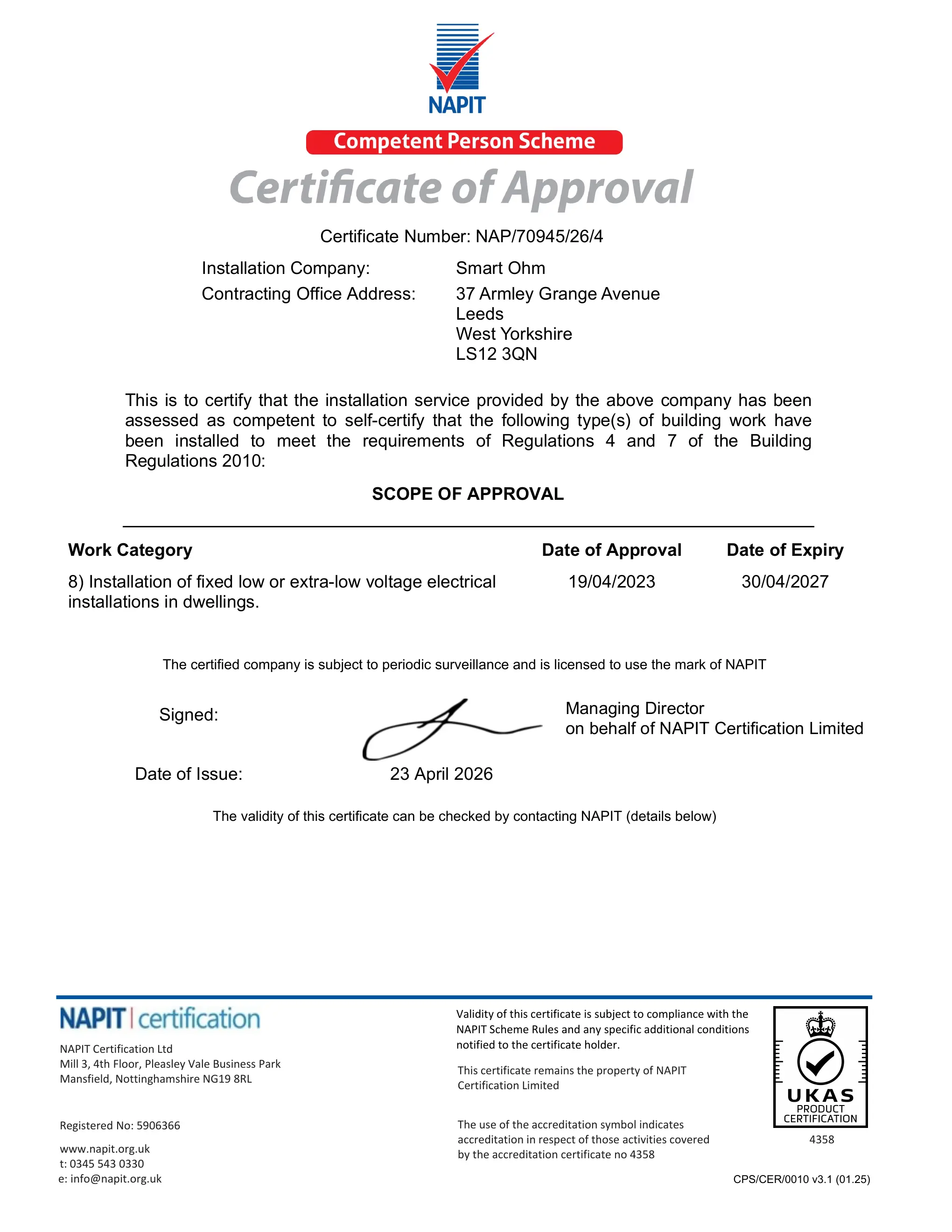
SmartOhm is registered with NAPIT under its Competent Person Scheme.
Our approved scope states:
Work Category 8 – Installation of fixed low or extra-low voltage electrical installations in dwellings.
Our NAPIT certificate confirms that SmartOhm has been assessed as competent to self-certify qualifying work within this scope as meeting the relevant requirements of the Building Regulations.
This is one of the practical benefits of employing a suitably registered electrician.
NAPIT explains that its Competent Person Scheme allows registered electrical businesses to self-certify qualifying notifiable domestic electrical installation work, rather than the customer having to deal with the normal Building Control route themselves.
For our customers, that keeps things straightforward.
Where we carry out qualifying notifiable electrical work that falls within our registered scope, we deal with the notification process for you.
We carry out the work.
We inspect and test it.
We provide the appropriate electrical certification.
And we deal with the relevant Building Regulations notification.
You’re not left at the end of the job wondering what paperwork you’re supposed to have.
What does our NAPIT Full Scope registration cover?
This is another point that’s worth understanding.
Not every person displaying an electrical scheme logo necessarily has the same registered scope of work.
SmartOhm holds NAPIT Full Scope electrical registration, and our NAPIT certificates identify the actual categories of work for which we have been assessed.
There are three particularly relevant parts to our registration.
1. Electrical installation work
Under the Electrotechnical Installation Certification Scheme, SmartOhm has been successfully assessed against the requirements of the IET Electrotechnical Assessment Specification.
Our scope of approval covers:
A1 – Electrical installations up to and including 1000V AC or 1500V DC
A1.1 – Dwellings covered by BS 7671
A1.2 – Other than dwellings covered by BS 7671
In practical terms, our assessment recognises our technical competence within these categories to undertake electrical work involving areas including:
- Design
- Construction and installation
- Maintenance
- Verification
- Inspection
- Testing
This means our assessed scope isn’t limited to electrical work in houses.
We are also assessed for electrical installation work in premises other than dwellings within the scope of our registration.
2. Competent Person Scheme registration
Our second area of registration relates specifically to Building Regulations self-certification for domestic electrical work.
Our approved scope is:
Work Category 8 – Installation of fixed low or extra-low voltage electrical installations in dwellings.
This is what allows us to self-certify qualifying notifiable electrical work within our registered scope through NAPIT’s Competent Person Scheme.
For homeowners, this is particularly relevant when having work carried out such as:
- Consumer unit replacements
- New electrical circuits
- Rewires involving new circuits
- Other qualifying notifiable electrical installation work
NAPIT is authorised to operate Competent Person Schemes supporting self-certification against Building Regulations requirements.
It means we can deal with the compliance process as part of the electrical job rather than leaving the customer to try to sort it out afterwards.
3. Electrical inspection and testing
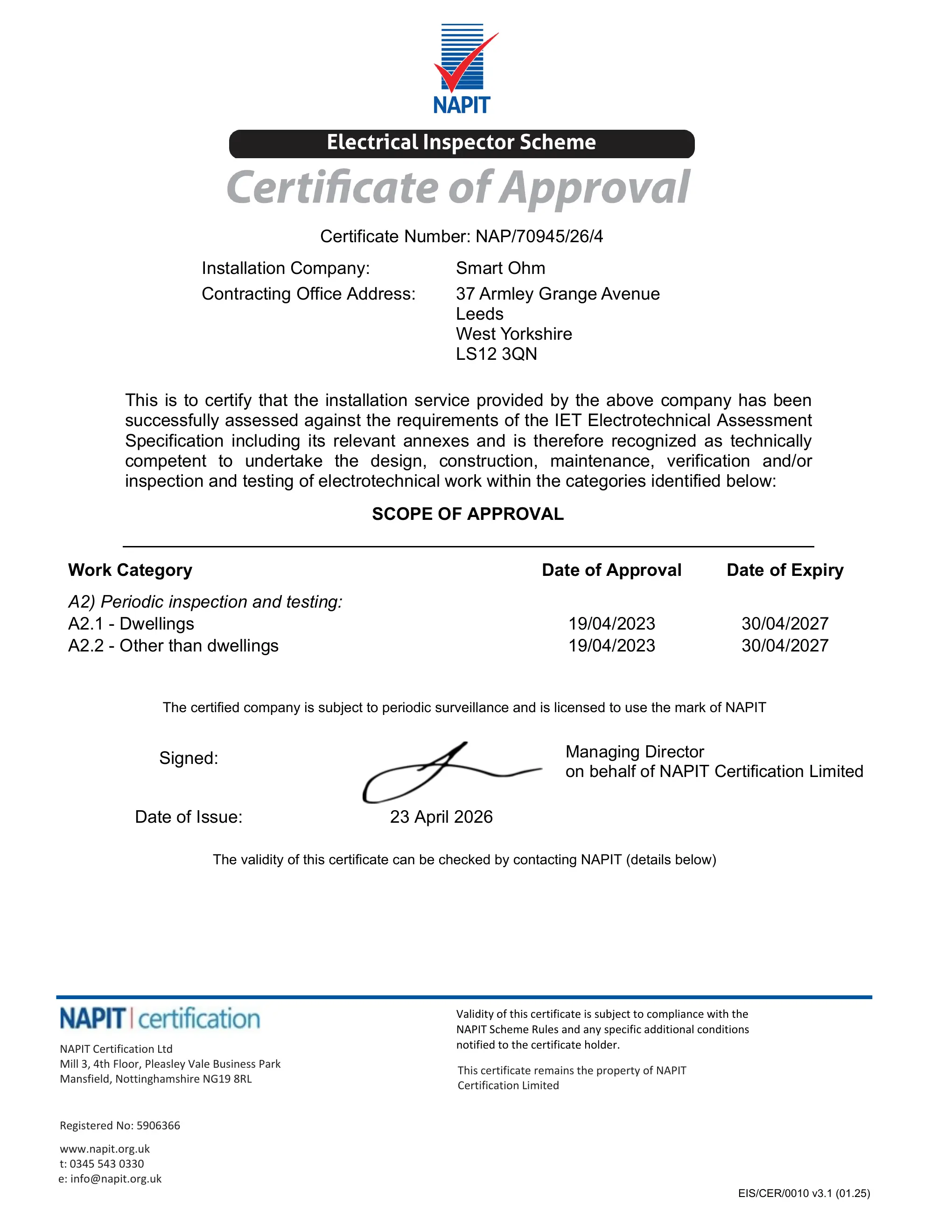
SmartOhm is also separately registered under NAPIT’s Electrical Inspector Scheme.
Our approved scope covers:
A2 – Periodic inspection and testing
A2.1 – Dwellings
A2.2 – Other than dwellings
This is important for work such as Electrical Installation Condition Reports (EICRs) and periodic electrical inspections.
NAPIT’s Electrical Inspector Scheme requires scheme work to be carried out in accordance with BS 7671, and NAPIT has specific competence requirements for those carrying out periodic inspection and testing.
Inspection and testing isn’t simply a case of plugging in a tester and producing a certificate.
An electrician needs to understand the installation they’re looking at.
They need to recognise defects and signs of deterioration.
They need to know which tests are appropriate.
They need to interpret the results correctly.
And they need to make proper professional judgements about the condition and safety of the installation.
That’s why independently assessed competence for inspection and testing is important.
Our competence is subject to ongoing assessment
I’ve worked hands-on in electrical and smart home installation for 21 years.
That experience matters.
There are plenty of things you only learn from years of actually working on electrical installations in customers’ homes and dealing with the problems you find.
But experience doesn’t mean somebody should stop having to demonstrate competence.
Electrical regulations change.
Equipment changes.
Installation methods develop.
Testing requirements change.
And electricians need to keep their technical knowledge up to date.
SmartOhm has been NAPIT registered since 2023, and our registration is subject to ongoing assessment.
NAPIT describes Full Scope electrical competence in terms of electricians and inspectors being monitored and regularly assessed to demonstrate their competency.
I see that as a positive part of being registered.
It means we’re not simply saying:
“I’ve been doing this for years, so you’ll have to take my word for it.”
Our experience is backed up by independent assessment of the qualifications, knowledge and competence required for the categories of work within our registration.
For somebody looking for a NAPIT registered electrician in Leeds, that’s useful reassurance.
We use independently calibrated electrical test equipment
There is another part of electrical work that customers rarely see.
The test equipment we use is independently checked and calibrated each year to ensure it is performing correctly.
Why does that matter?
Because electrical testing relies on accurate readings.
When we’re using those results to verify electrical work, assess an existing installation or make decisions about electrical safety, we need confidence in the equipment producing those readings.
It’s one of those things that happens behind the scenes.
Customers probably won’t ask about it.
But it’s part of carrying out electrical work properly.
Coming back to the West Park job in LS16 5DS
The homeowner in West Park, Leeds, LS16 5DS hadn’t knowingly done anything wrong.
They’d employed somebody to replace their consumer unit.
The work had been completed.
They’d been handed an Electrical Installation Certificate.
As far as they were concerned, that was the paperwork sorted.
And that’s completely understandable.
If you’re not an electrician, an Electrical Installation Certificate is mostly pages of circuit details, test results, figures and technical terminology.
You have to rely on the person carrying out the work to understand what needs doing.
That’s why checking who you’re employing matters.
The missing Building Regulations Compliance Certificate didn’t automatically prove that the previous work was illegal or that the consumer unit had been installed incorrectly.
There are legitimate Building Control routes available outside the normal Competent Person Scheme self-certification process.
Approved Document P recognises different routes for demonstrating compliance with notifiable electrical work.
But the missing certificate did mean the customer needed to establish how the Building Regulations notification had been dealt with.
That’s an inconvenience most homeowners would rather avoid.
And it’s a good real-world example of why we recommend checking that the electrician you employ is appropriately registered before the work starts.
An electrical certificate on its own doesn’t answer every question
This is worth making clear because we’re not suggesting an Electrical Installation Certificate is unimportant.
It absolutely is important.
But it has a particular purpose.
For notifiable work, the question isn’t simply:
“Did I get an electrical certificate?”
It’s also:
“Was the Building Regulations side dealt with correctly?”
Someone without electrical knowledge isn’t expected to look at a sheet full of test results and somehow determine whether the whole compliance process has been followed.
That’s why the registration of the person carrying out the work matters.
With SmartOhm, if the work falls within our Competent Person Scheme scope and requires notification, we’ll explain that and deal with the notification as part of the job.
What happens when you book electrical work with SmartOhm?
Our process is straightforward.
First, we’ll discuss what you’re looking to have done.
For jobs that need to be surveyed before we can quote properly, we’ll arrange a visit.
Before adding to or altering an existing electrical installation, I’ll look at the parts of the installation that are relevant to the proposed work.
Depending on the job, that can include:
- The consumer unit
- Earthing arrangements
- Protective bonding
- Existing circuits
- Protective devices
- The general suitability of the existing installation for the planned work
There’s a reason for doing this before quoting.
If something about the existing installation affects the work we’re planning, I’d rather identify it at the beginning than discover it halfway through the job.
If I find something that needs addressing, I’ll explain what I’ve found and why it matters.
You then get a quote based on what the job actually requires.
Once the work is completed, we inspect and test it using our calibrated electrical test equipment.
We provide the appropriate electrical certification.
And where the work is notifiable and falls within our Competent Person Scheme scope, we’ll deal with the required notification.
It’s a straightforward process, but it means the important details aren’t being left until the end.
Common mistakes we see when people arrange electrical work
Most problems aren’t caused by customers deliberately trying to cut corners.
Usually, it’s simply that they didn’t know what they were supposed to ask.
Some common issues include:
- Assuming anybody advertising themselves as an electrician has the same qualifications or registered scope
- Not checking whether the electrician is registered with an appropriate Competent Person Scheme
- Assuming an Electrical Installation Certificate automatically means Building Regulations notification has taken place
- Not asking what certificates will be provided before the work starts
- Not checking whether significant electrical work is notifiable
- Waiting until a house sale or another electrician visits before trying to find missing paperwork
In most cases, these problems are much easier to avoid at the start than they are to sort out later.
Ask the questions before appointing somebody.
A professional electrician shouldn’t mind.
Don’t just look for a NAPIT logo – check the registration
We’re quite happy for customers to check our credentials.
In fact, that’s one of the reasons we’ve created this page.
NAPIT provides consumer information and facilities to help customers identify registered scheme members.
Our details are:
SmartOhm Electrical and Smart Home
NAPIT Registered Since: 2023
NAPIT Certificate Number: NAP/70945/26/4
Registration: Full Scope Electrical
Electrical Installation Scope: A1.1 – Dwellings A1.2 – Other than dwellings
Electrical Inspector Scope: A2.1 – Dwellings A2.2 – Other than dwellings
Competent Person Scheme: Work Category 8 – Fixed low or extra-low voltage electrical installations in dwellings
If you’re comparing electricians, we’d suggest asking:
Are you registered for the type of work you’re quoting me for?
Is this job notifiable under the Building Regulations?
What certificates will I receive?
Who deals with the Building Regulations notification?
Can I independently verify your registration?
Those are perfectly reasonable questions.
More than a badge on our website
NAPIT registration is one way customers can independently check who they’re dealing with.
But it isn’t the only trust signal behind SmartOhm.
SmartOhm Electrical and Smart Home is:
- NAPIT Registered – Full Scope
- NAPIT registered since 2023
- TrustMark approved
- A Which? Trusted Trader
- Backed by 21 years of hands-on electrical and smart home installation experience
- Rated with more than 85 five-star Google reviews
Those things are useful when you’re deciding who to let into your home.
But ultimately, the way the work is carried out matters just as much as the logos.
We check the installation we’re connecting to.
We explain what we find.
We use independently calibrated electrical test equipment.
We inspect and test our work.
We provide the appropriate electrical certification.
And where qualifying work requires Building Regulations notification through our registered scope, we deal with it correctly.
That’s what we believe you should expect from a professional registered electrician.
Looking for a NAPIT registered electrician in Leeds?
SmartOhm Electrical and Smart Home provides electrical installation, inspection, testing and smart home services throughout Leeds and surrounding areas.
We work with homeowners across Leeds, including areas such as West Park, Alwoodley, Roundhay, North Leeds and the surrounding villages.
If you’re planning electrical work and want to know what is involved before committing to anything, we’re happy to advise.
That might be:
- A consumer unit replacement
- New electrical circuits
- Electrical alterations
- A rewire
- Inspection and testing
- An EICR
- Fault finding
- General electrical installation work
- Electrical work as part of a wider smart home installation
We’ll look at what you’ve currently got, explain what is required and let you know what certification or notification applies to the work.
No hard sell.
Just straightforward advice based on what we find.
If you’re dealing with this, get in touch.
Or, if you’ve had previous electrical work carried out and you’re not sure about the paperwork, send us a photo and we’re happy to take a look and point you in the right direction.
Frequently Asked Questions
Is SmartOhm NAPIT registered?
Yes.
SmartOhm Electrical and Smart Home has been NAPIT registered since 2023.
Our registration covers Full Scope electrical installation work in dwellings and premises other than dwellings, periodic inspection and testing in both categories, and Competent Person Scheme registration for qualifying electrical installation work in dwellings.
Our NAPIT certificate number is:
NAP/70945/26/4
What does NAPIT Full Scope mean?
In simple terms, our NAPIT registration isn’t restricted to a small defined category of electrical work.
SmartOhm has been assessed for:
A1.1 – Electrical installations in dwellings covered by BS 7671
A1.2 – Electrical installations other than dwellings covered by BS 7671
We’re also separately assessed under the Electrical Inspector Scheme for periodic inspection and testing in dwellings and premises other than dwellings.
Our certificate identifies the exact categories of work for which we’ve been assessed.
Does NAPIT assess an electrician’s competence?
NAPIT certification schemes require electrical businesses and individuals to demonstrate competence against the applicable scheme requirements.
NAPIT also describes Full Scope electricians and inspectors as being monitored and regularly assessed to demonstrate competence.
SmartOhm’s registration is subject to ongoing assessment rather than simply being a badge obtained once and forgotten about.
What is a Competent Person Scheme?
A Competent Person Scheme allows appropriately registered tradespeople to self-certify qualifying work as meeting the relevant Building Regulations requirements.
For electrical work, this can allow registered businesses to deal with the notification of qualifying domestic electrical installation work on the customer’s behalf.
SmartOhm is registered with NAPIT’s Competent Person Scheme for fixed low or extra-low voltage electrical installations in dwellings within our approved scope.
What electrical work needs Building Regulations notification?
Not all domestic electrical work is notifiable.
In England, the main categories include:
- Installation of a new circuit
- Replacement of a consumer unit
- Certain additions or alterations to existing circuits within a special location
The current Approved Document P explains the notification requirements applying to electrical work in dwellings.
If you’re unsure whether your planned work is notifiable, ask us.
We’ll explain what applies to the job.
Is an Electrical Installation Certificate the same as a Building Regulations Compliance Certificate?
No.
They serve different purposes.
The Electrical Installation Certificate records information relating to the electrical installation, inspection and testing.
Where electrical work is also notifiable under the Building Regulations, the Building Regulations compliance side needs to be dealt with through an appropriate route.
So an EIC by itself does not demonstrate that Building Regulations notification has taken place.
I had a consumer unit replaced but didn’t receive a Building Regulations Compliance Certificate. What should I do?
Start by contacting the electrician or business that carried out the work.
Ask them how the consumer unit replacement was notified under the Building Regulations and what route was used.
Don’t automatically assume the work is unsafe simply because you can’t find a particular certificate.
There are different legitimate routes for dealing with Building Regulations compliance.
But a replacement consumer unit is notifiable work in England, so it is sensible to establish how that requirement was dealt with.
If you’re not sure what paperwork you’ve been given, send us a photo and we’ll take a look.
Can SmartOhm carry out EICRs?
Yes.
SmartOhm is registered under NAPIT’s Electrical Inspector Scheme for periodic inspection and testing in:
A2.1 – Dwellings
A2.2 – Other than dwellings
This is separate from our electrical installation scope and demonstrates our assessed competence for periodic electrical inspection and testing within these categories.
Does SmartOhm work outside domestic properties?
Yes.
Our NAPIT Electrotechnical Installation Certification Scheme scope includes:
A1.1 – Dwellings
and
A1.2 – Other than dwellings
Our Electrical Inspector Scheme scope also covers periodic inspection and testing in both dwellings and premises other than dwellings.
If you have a particular commercial or non-domestic project, get in touch and we’ll confirm whether the work falls within the services we provide.
How can I check SmartOhm’s NAPIT registration?
You don’t need to take our word for it.
You can independently check NAPIT registration through NAPIT’s consumer/member search facilities.
SmartOhm Electrical and Smart Home
NAPIT Certificate Number: NAP/70945/26/4
NAPIT Registered Electrical Work Across Leeds
If you’re looking for a NAPIT registered electrician in Leeds and want somebody who will look properly at the existing installation, explain what is required, test the work and deal with the relevant certification, get in touch with SmartOhm Electrical and Smart Home.
We’ve been working hands-on in electrical and smart home installation for 21 years, with SmartOhm registered with NAPIT since 2023.
We’ll take a look at what you’re planning and give you straightforward advice on the best way to deal with it.
Send over a photo or give us a call.